
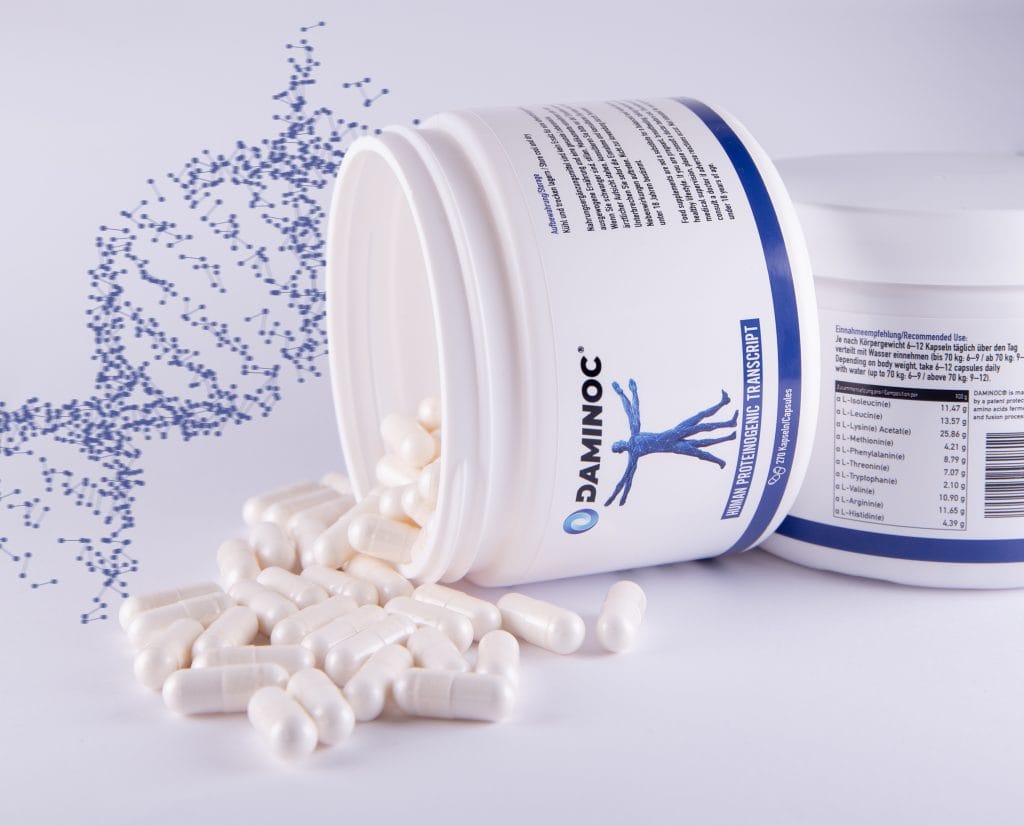
How does Daminoc® Human Amino Code work? And what does it actually do once it enters the body?
To start, an important clarification: Daminoc® Human Amino Code isn’t a “protein source” in the traditional sense – it is protein in its most refined form: pure amino acids. These amino acids are the fundamental building blocks from which the body constructs proteins in the first place.
Proteins only emerge when amino acids are linked into long chains. Every piece of food that contains protein — meat, fish, eggs, whey — consists of chains made of hundreds or thousands of amino acids.
But Daminoc® Human Amino Code is fundamentally different from any protein you’ve consumed before.
Before we get into the specific effects in the body, here’s the essential background:
Essential vs. Non-Essential Amino Acids
The human body uses 22 amino acids. Some of them are essential, others non-essential.
- Essential amino acids (EAAs): the body cannot produce them — they must come from outside.
- Non-essential amino acids: the body can produce them, but only if all required EAAs are present in the right proportions.
If even one essential amino acid is missing — or the ratio between them is off — the body cannot build new protein. Not muscle. Not collagen. Not enzymes. Not hormones. Nothing.
And unlike fat or carbohydrates, amino acids cannot be stored. What can’t be used immediately is converted into glucose or fat within hours.
Why Protein Sources Differ So Much
Every protein source has a unique amino acid profile.
The more precisely the ratio of EAAs matches the body’s own needs, the more of the ingested amino acids can be used to build new protein. The rest becomes energy — meaning calories.
Examples:
- Eggs: high quality — around 48% are usable for protein synthesis.
- Whey or plant proteins: significantly lower — less than half is effectively utilized.
- Daminoc: its profile matches the human requirement exactly — resulting in nearly 100% utilization.
This is why Daminoc® Human Amino Code is almost calorie-free: nearly everything is used, and almost nothing is converted into energy or waste.
What Happens When We Consume Amino Acids
The human body is essentially built from protein:
- muscles
- skin
- bones
- ligaments and tendons
- hormones
- enzymes
- immune cells
- digestive juices
- hair and nails
- cell membranes
More than 20,000 different proteins perform crucial tasks every second.
When we eat protein, the digestive system must break it into smaller chains and then into single amino acids before they can enter the bloodstream and be used by the cells.
But digestion becomes less efficient with:
- age
- chronic stress
- weakened stomach acid
- heavy or low-quality meals
If fewer amino acids are absorbed, less protein is built.
What a Protein Deficiency Can Lead To
A lack of usable protein shows up differently in every person, but the underlying mechanisms are universal.
1. Immune System
Amino acids are needed to build immune cells. When supply is low:
- you get sick more easily
- recovery takes longer
- energy levels drop
2. Hormone Production
Many hormones are made from proteins — thyroid hormones, adrenaline, cortisol, sex hormones. Too few amino acids can trigger:
- weight gain
- mood swings
- poor stress tolerance
- cravings
- low or unstable energy
- reduced muscle mass
3. Muscle Tissue
Maintaining muscle already requires a minimum protein supply. Building new muscle requires more. Without enough amino acids:
- muscle repair slows down
- growth plateaus
- strength declines
4. Skin + Collagen
Collagen is a protein. A deficit leads to:
- dryness
- wrinkles
- reduced elasticity
5. Bones
Bones rely on protein for structure and repair. Without adequate amino acids, micro-fractures accumulate, leading to soreness and eventual fragility.
6. Digestion
Digestive enzymes and stomach acid are proteins. If you can’t produce enough:
- protein digestion weakens
- fewer amino acids are absorbed
- the deficiency worsens
This explains why older adults lose muscle and bone density faster: they absorb less of the protein they consume.
Why Daminoc® Human Amino Code Is Different
Daminoc provides:
- all essential amino acids
- in the human-optimal ratio
- fully isolated as free amino acids
This means the digestive system has nothing left to break down. Even weak digestion absorbs Daminoc instantly and completely.
Many users find that with 3–4 servings per day they receive more usable protein than from their entire diet combined.
All without calories or metabolic waste.
Protein Quality and Kidney Load
Unused amino acids must be broken down. This releases nitrogen, which the kidneys must eliminate.
The lower the protein quality, the more nitrogen is produced.
- Daminoc: almost no nitrogen waste
- Eggs: ~50% breakdown → moderate nitrogen load
- Whey/plant protein: >80% breakdown → high load
- BCAAs: almost 100% unusable → extremely high waste load
This explains why some athletes develop kidney issues when consuming large amounts of low-quality proteins and isolated amino acids.
Daminoc avoids this completely because virtually nothing is degraded.
What Users Commonly Experience
Depending on how large the underlying protein deficit was, people often report:
- faster recovery
- more stable energy
- better digestion
- stronger hair and nails
- smoother, fuller skin
- improved mood balance
- noticeable muscle gain
- improved tendon issues
- fewer signs of aging
- better hormonal regulation
Not everyone experiences everything — but considering every system in the body depends on protein, the range of effects makes perfect sense.