If you have read our statements about Daminoc®, you may have a few questions:
The first assertion is that not all proteins are the same. That different proteins, once digested and absorbed, provide our bodies with different amounts of usable protein.
For example, if you consume 1 gram of whey protein, your body will not get the same amount of usable protein for building new muscles, bones, tissues, etc. as from 1 gram of protein from whole eggs.
The second claim is that the assumption that we get 4 calories for every gram of protein we consume is a misconception. And that this points to a general lack of understanding of what calories are outside of the scientific community and what they have to do with muscle building, energy and body fat.
A calorie is not a thing, but a measure of energy production: how much energy is produced when one gram of carbohydrate, protein or fat is broken down and burned as fuel to produce energy.
When we consume carbohydrates, most of them are broken down and used for immediate energy production. Or they are used to form glycogen (sugar) or body fat – energy stores for the future.
The situation is different with proteins or even fats. A significant proportion of the fats we consume are used to produce new cells or hormones. Only some of it binds with sugar molecules and is stored as body fat.
And of course, not all the protein we consume is used as fuel. Some is used to build or repair muscles, cells, hormones, bones, skin and so on. There is no energy production here, so there are “no” calories.
So if one gram of carbohydrates, protein or fat were used entirely for energy production, we would receive 4 calories (for carbohydrates and protein) or 9 calories (for fat) – provided they were used entirely for energy production.
In addition, not only are less than 4 calories of energy produced from each gram of protein, but we also produce a different amount of energy, measured in calories, depending on which protein source we consume: Eggs, soy, meat, fish, whey, peas, collagen, etc.. Each of them provides our body with a different amount of energy, measured in calories.
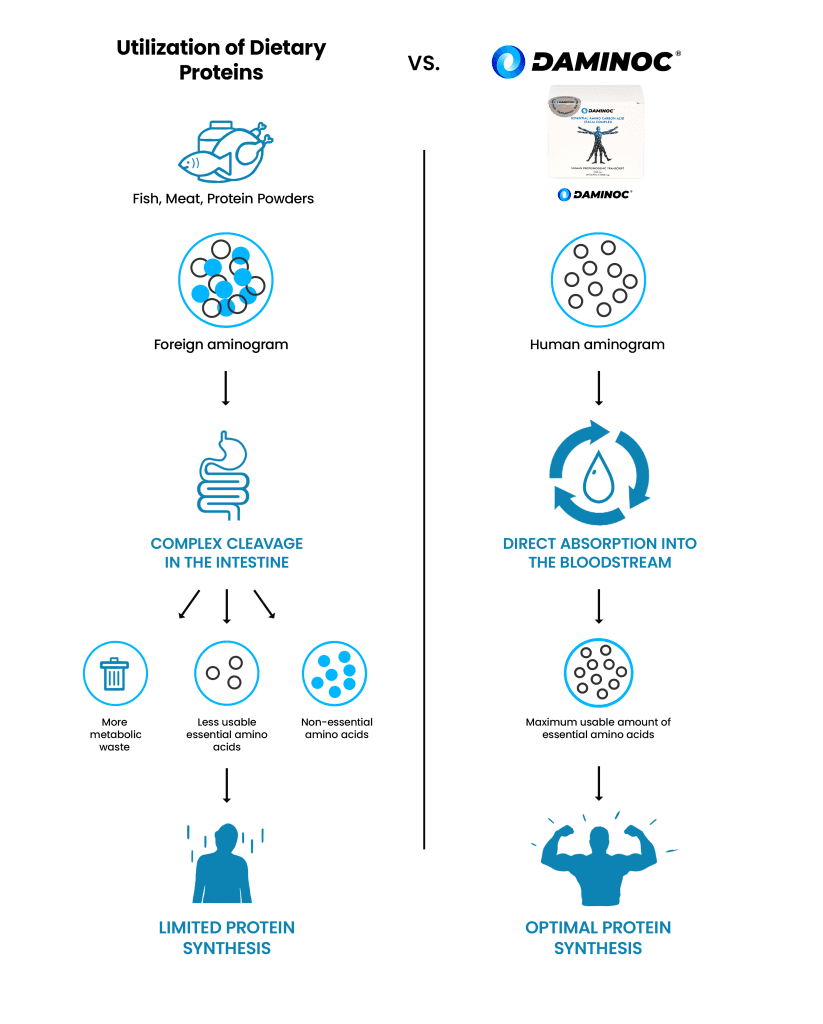
The third claim is that Daminoc® is a source of pure, free, essential amino acids that is 99% utilized for the synthesis of new protein in the human body and therefore provides almost no actual calories.
The fourth claim is that the EAA (Essential Amino Acids) complex in Daminoc® matches the EAA pattern of our body’s protein, making it much easier to absorb and synthesize.
And the fifth claim that Daminoc is 4 times more valuable than any other protein source, meaning that we need much less to get the same amount of protein building blocks as we get from a piece of meat, fish or poultry.
We will do our best to substantiate these claims here.
But first we need to look at what protein actually is and what happens to it when it enters our bodies:
Proteins are not just “proteins”. A protein is a molecule made up of smaller molecules called amino acids. (1,8,13)
Proteins are nothing more than amino acids held together by peptide bonds. (Collagen is also just one type of protein).
Around 500 different amino acids are known, but only around 20 are used in the human body to produce proteins. (14)
To produce or “synthesize” a protein, these amino acids are joined together to form long chains of hundreds or thousands of different amino acids. The chains are then split, with new bonds holding the coils in place. These look similar to a coiled rope. (1,15)
But these proteins can contain any type and amount of different amino acids.
And each protein with different amounts of the various amino acids is different and differs from the others. These differences are necessary because they each fulfill a different function in the body. (3)
Amino acid composition and sequence determine the native structure, functionality and nutritional quality of a protein in a given environment. (16)
In fact, there are around 20,000 different, precisely defined proteins in the human body, which differ in type and quantity of amino acids. (2, 8)
The amino acids that a particular protein contains are referred to as the amino acid profile.
WHAT HAPPENS TO PROTEIN WHEN IT IS DIGESTED AND ABSORBED?
A big misconception is that when we ingest proteins, they are broken down into “protein molecules” and then get to where they are needed.
However, this is not the case. When the protein has been digested, absorbed and utilized in the body, it is in a completely different form than when it was ingested. It has been completely broken down and completely rebuilt into the form that the body needs at that time. (19)
We don’t have egg protein molecules or whey protein molecules in our muscles, and we don’t have powdered collagen molecules in our skin or bones.
When we consume protein, it undergoes a very precise sequence of processes.
First it is broken down in the stomach.
The proteins we have eaten are pulled apart by stomach acid and digestive enzymes, and then the individual chains are unwound and broken up. (20)
They are not broken down into individual amino acids, but into much smaller, uncoiled chains of around 20-40 amino acids in length.
These short-chain amino acids then pass from the stomach into the small intestine, where new enzymes are released.
These new enzymes further break down these short amino acid chains until all the bonds holding the amino acids together are completely broken and each amino acid floats freely (hence the term “free” amino acid), with no connection to another amino acid. (21)
So now we have complex proteins, assembled in the form of meat, eggs, soy or collagen, completely broken down into tens or hundreds of thousands of individual, unconnected amino acids.
Now these amino acids can be converted into any of the more than twenty thousand forms of protein that our body needs. (21)
These individual amino acids are then absorbed through the walls of the small intestine, pass through the liver and are released into the bloodstream, where they can be taken up by individual cells throughout the body and assembled (synthesized) into new proteins of the exact type or types needed by that particular cell. (22)
And this is where calories come into play and the question of how much of the protein we eat is actually consumed.
This is because these cells do not need just any type or quantity of amino acids to form new proteins. They have a very precise requirement.
ESSENTIAL VS. NON-ESSENTIAL AMINO ACIDS
There are two main types of amino acids: essential amino acids and non-essential amino acids. (These are also known as essential amino acids and non-essential amino acids).
Non-essential amino acids or dispensable amino acids are amino acids that the human body can produce (synthesize) itself and therefore do not need from external protein sources in the diet. (8)
Essential amino acids (EAAs) or indispensable amino acids are amino acids that the body cannot produce itself, so we must obtain them from an external protein source. (8)
The trick and the good thing about it is that the non-essential amino acids are produced with the help of the essential amino acids.
We need the essential amino acids to produce all the non-essential amino acids we need.
What’s more, we need all the essential amino acids to produce all the proteins our body needs.
Without all essential amino acids, our body cannot build proteins.
If it lacks even one, it cannot produce a new protein. (7, 10)
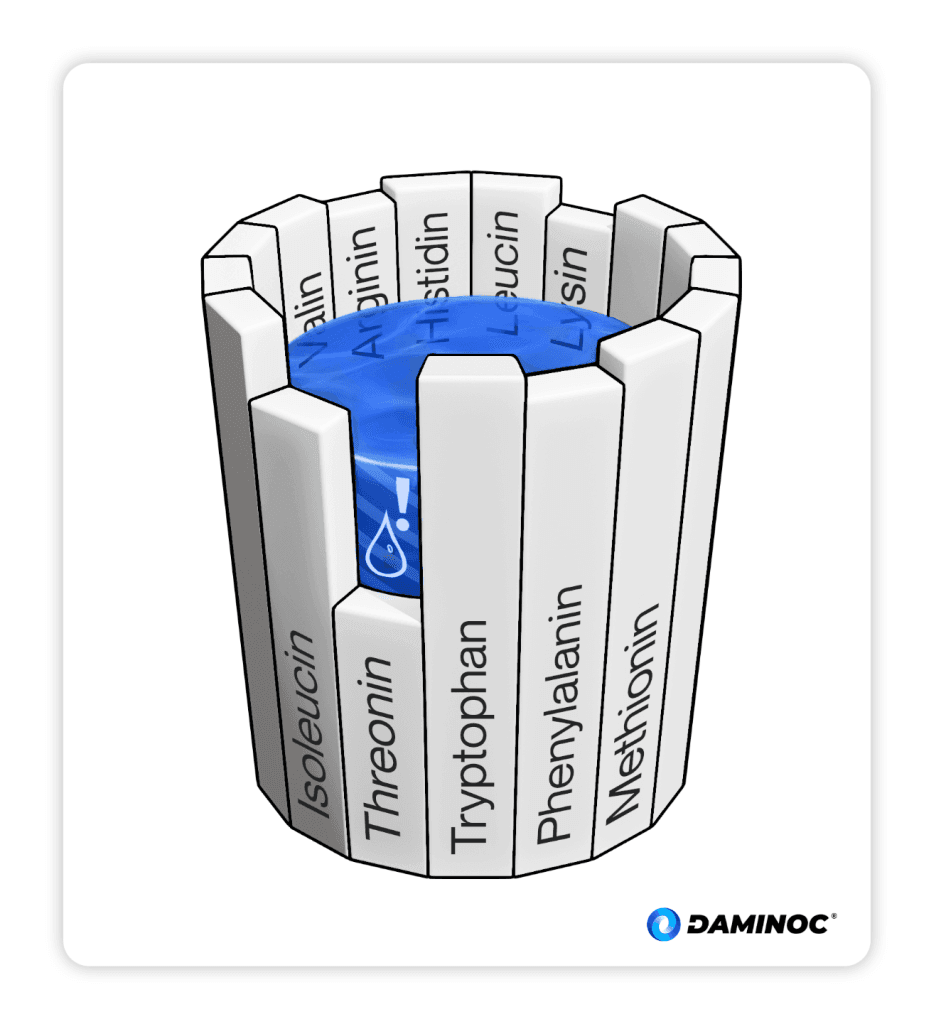
This missing amino acid is called a “limiting” amino acid because when it is missing, or to the extent that it is missing, it limits the amounts of the other essential amino acids that can be used to synthesize new protein. (7, 9)
The biological value of dietary proteins depends on the amino acids that compose them, and it has been shown that if the essential amino acids are not simultaneously available at the time of protein synthesis, the intracellular deficit, even if it is only a single amino acid, limits the body’s protein synthesis. (11)
This is why BCAAs, three of the essential amino acids (valine, leucine, isoleucine) known as branched-chain amino acids and touted for building new protein, don’t actually build new protein. (10)
It is physically impossible for them to do this.
The body needs every single one of the essential amino acids to build new protein. If it lacks even one, no new proteins can be formed. (7)
In addition, it does not need any additional non-essential amino acids. It produces non-essential amino acids itself to the extent that it needs them for the proteins it has to produce.
But that’s not all.
It not only needs each of the essential amino acids. It needs them in a precise ratio to each other.
The more similar the dietary proteins are to the body’s proteins in terms of their amino acid composition, the less effort the body needs to convert them. The content of essential amino acids is of particular importance here. This concept of biological value was developed by the German nutritionist Karl Thomas (1883-1969) at the suggestion of Max Rubner.
Normal growth and the maintenance of human health require that all amino acids (essential and non-essential amino acids) are provided in adequate amounts and in a bioavailable form (Pencharz and Young 2006). This aspect, commonly referred to as availability or bioavailability, is very important to know because dietary proteins vary widely in both the concentration and bioavailability of essential amino acids. (6)
As the amino acid profile of dietary proteins is never identical to the amino acid profile of body proteins, they are said to be of “lower quality”. The quantity of amino acids contained in the dietary protein is not a limiting factor for protein synthesis. The limiting factor is the concentration of the amino acid that has the greatest deficit in relation to the requirement. This brings us back to the limiting amino acid. If a limiting amino acid is used up, the body cannot produce any more of its own proteins. Similar to a puzzle, it then lacks the right building block. This results from the fact that humans can only convert amino acids into the body’s own protein to the extent that the smallest amount of an amino acid is available.
A simplified example for better understanding:
In the following example, we assume that the body needs exactly the same amount of each of the three amino acids ingested to build up body protein. We also assume that these are essential (non-self-producing) amino acids.
Intake of amino acid x: 13.8 grams
Intake of amino acid y: 5.4 grams
Intake of amino acid z: 9.7 grams
This means that 5.4 grams of each amino acid supplied could be processed, as amino acid y is only available in limited quantities.
If the body receives all EAAs, but some of them are supplied in insufficient quantities, it cannot fully utilize the others.
If all but one of the EAAs are present in the correct ratio to form 10 grams of new protein, but the amount of only one of these amino acids is only sufficient to form 3 grams of new protein together with the other 3 grams, then the body can only form 3 grams of protein, no matter how many of the other essential amino acids are present. (11)
Graphic example of Liebig’s barrel according to Justus Liebig for illustration:
For example, if we want to build a table, we need a table top and four legs to build it.
If we had two table tops and 7 legs, we could still only build one table because one leg is missing.
Although there are more than 2 EAAs, the principle is the same. Our body can only build as much new protein as it has each of the essential amino acids available in the correct ratio to each other. If we want tenfold protein synthesis, we need to increase each EAA tenfold according to its ratio. (10)
If only one or two of them are increased, the increased amount is actually a surplus and cannot be used by the body to produce new protein.
And this is where the different types of proteins come into play.
Although whey, peas, soy, meat, eggs, etc. can all contain EAAs, the ratio of EAAs to each other is different.
How much new protein our body can synthesize from the EAAs in a particular protein source depends on how much of each EAA is present in the correct ratio in that protein source. (6)
The nutritional quality of a dietary protein depends on the absolute content of essential amino acids, the relative proportions of essential amino acids and their ratio to non-essential amino acids. (16)
If a protein source, such as whey, consists of only 18% essential amino acids in the correct ratio to form new protein, and the other 82% consists of single essential amino acids that exceed the correct ratio, or other non-essential amino acids, then only 18% of the whey consumed can be used in the body to form new protein.
The other 82% of the protein (essential and non-essential amino acids) is surplus and therefore cannot be used to form new protein.
And this is where the calories come into play again.
Because this surplus is not stored or kept for later, but the body has to do something with it.
GLUCONEOGENESIS: HOW IS PROTEIN CONVERTED INTO ENERGY (CALORIES)?
If the body has excess sugar (carbohydrates) that it does not need, it has a way of storing it for later.
It links the individual sugar molecules into chains. These sugar chains are called glycogen and are stored in the muscles and liver. (17)
When our cells need more energy and there is no more sugar in the bloodstream, the body breaks these glycogen chains back down into individual sugar molecules and releases them into the bloodstream so that the cells can use them.
And when the body has so much excess sugar that it has filled all the body’s glycogen stores and still has too much, it combines these sugars with fatty acids, forms triglycerides and stores them in our fat cells as body fat. (18)
In this way, the extra fat that we consume is also stored. If the body has more fatty acids available than it can use for energy or cell building, it combines the fatty acids with sugars and stores them as body fat in our fat cells.
The body has no such storage facility for amino acids. They are either synthesized into new proteins or cannot be used. (4, 5, 10)
When we consume proteins and they are completely broken down into amino acids, these amino acids are released into our bloodstream so that the cells can use them.
However, these amino acids only remain in our bloodstream for a few hours on average. If they are not used up during this time because they exceed our needs, the body has to do something with them.
Amino acids are molecules that can be broken down again. And if they cannot be used to synthesize new proteins, this is exactly what happens.
When amino acids are in excess, the body has no capacity or mechanism for storing them; therefore, they are converted to glucose or ketones, or they are broken down. (5)
An amino acid molecule contains an amino group, a carboxylic acid group and a side chain that is specific to each amino acid.
Most carbohydrates from the breakdown of amino acids are converted into pyruvate, intermediate products of the TCA cycle or acetyl-CoA. During fasting, these carbons are converted into glucose in the liver and kidneys or into ketone bodies in the liver. In a well-fed state, they can be used for lipogenesis (the metabolic formation of fat). (4)
This is where the statement “protein has calories” comes into play. Calories measure how much energy could potentially be generated by breaking down the amino acids in a protein or by breaking down a carbohydrate or fat.
But that is only the potential.
Calories are the amount of energy released when the body breaks down (digests and absorbs) food.
When the amino acids were used to build new proteins, they were not broken down and no energy was released.
Only the excess amino acids that could not be used to build new proteins undergo gluconeogenesis and are broken down, releasing glucose (sugar) and ketones, or they are oxidized directly as fuel – the energy is measured in calories.
When we eat protein and build muscle, obviously at least some of the amino acids from the protein we eat are converted into new protein instead of being used as energy.
HOW WE KNOW HOW MUCH OF A PROTEIN SOURCE IS USED AND HOW MUCH IS CONVERTED INTO ENERGY (CALORIES)
The most important elements of an amino acid are carbon, hydrogen, oxygen and nitrogen.
The decomposition of amino acids produces hydrocarbons and nitrogenous waste. However, high concentrations of nitrogen are toxic as they produce ammonium ions. The urea cycle processes the nitrogen and facilitates its elimination from the body. (5)
This element of nitrogen as a component of an amino acid is of crucial importance.
When an amino acid is deaminated, this nitrogen is released. This is largely measurable via urine and to a lesser extent via faeces and sweat and enables an accurate measurement of amino acid utilization in the human body.
When amino acids follow the anabolic pathway (protein synthesis), nitrogen is not released as it is still part of the amino acid that has now been used as part of a protein in the body’s structure.
However, if there is an excess of amino acids, they follow the catabolic pathway (amino acid degradation or deamination) in which they are broken down. This releases the nitrogen that was part of the amino acid.
The weight of the nitrogen in an amino acid is known and can be measured.
To be precise, the molecular weight of an amino acid is 110Da, and nitrogen makes up 16% of an amino acid. (13)
We can therefore measure the total nitrogen of a protein source before consumption and then measure the nitrogen release afterwards, so that we can see exactly how much of the protein consumed has been anabolized (synthesized into new proteins) and how much has been catabolized (broken down into its components).
If the amino acid has been anabolized, it is now part of the body’s protein structure and has not caused any energy release. And no nitrogen is released from it.
When catabolized, the amino acid was deaminated, resulting in an energy release and the release of its nitrogen component, which can now be removed via urine and to a lesser extent via sweat and faeces.
With most common proteins, 50-80 g of glucose can be obtained from 100 g of ingested protein. (12)
An example: If we take 10 grams of protein and nitrogen makes up 16% of each of the amino acids that make up that protein, then we know that there are 1.6 grams of nitrogen in 10 grams of protein.
If we then realize that half of this 1.6 grams of nitrogen was released through urine, feces and sweat (0.8 grams), then we know that only half of the amino acids in the 10 grams of protein were used to synthesize new protein, while the other half was deaminated and used as an energy source, i.e. calories.
So out of 10 grams of protein consumed, the body has only actually used 5 grams to build new protein. In addition, we now know that 5 grams have been converted into energy, i.e. calories, so that we get 20 calories from these 5 grams, as each gram of protein has the potential energy of 4 calories.
Supported by the analysis of human body protein (Bocobo, Skellenger, Shaw and Steele, Amino Acid Composition of Some Human Tissues) in the form of autopsy forensic studies of the amino acid profiles of human organs and tissues and comparative studies of nitrogen levels in urine and faeces, we now know the exact ratio of essential amino acids required by the body to synthesize new protein with near zero excess.
When we compare this proprietary formula of Daminoc® with the amino acid profiles of other protein sources, we are able to calculate the amount of amino acids each protein contains that is actually used for protein synthesis, as opposed to what is deaminated and converted into energy, i.e. calories.
If we look at the amino acid profiles of whole hen’s eggs, we see that 48% of the essential amino acids are present in the right proportions for them to be synthesized into new proteins in the human body, and 52% of the amino acids are present in excess.
This means that almost half of the protein in a whole egg is used to build new protein in the body and just over half is converted into energy, giving the whole egg an effective calorie value of 2.08 per gram. This is the highest ratio found in food in nature.
It is therefore no coincidence that the whole egg was used at the time (albeit arbitrarily) as a measure for calculating biological value. (24)
In whey, the EAAs make up 18% of the amino acid profile in the correct ratio for the synthesis of new protein, resulting in 82% excess amino acids that need to be deaminated. This results in an effective calorie value of 3.28 calories per gram of whey.
And in the case of BCAAs (branched-chain amino acids), which consist of only three of the essential amino acids and therefore cannot be used alone to synthesize new protein, we find that they are entirely excess amino acids and are subject to deamination.
A comprehensive literature search revealed no human studies quantifying the response of muscle protein synthesis to orally ingested BCAAs alone and only two studies evaluating the effect of intravenously infused BCAAs alone. Both studies with intravenous infusion found that BCAAs reduced both muscle protein synthesis and protein breakdown, implying a reduction in muscle protein turnover. The catabolic state, in which the rate of muscle protein breakdown exceeds the rate of muscle protein synthesis, persisted during BCAA infusion. (10)
SUMMARY
Not all proteins are the same.
Proteins are made up of amino acids, which are divided into essential amino acids, which we have to take in with our food, and non-essential amino acids, which our body can produce itself.
To form new protein, our body needs each of the essential amino acids.
If even one is missing, our body cannot produce new proteins.
The essential amino acids must also be in a precise ratio to each other.
Any amino acid that exceeds this ratio leads to a surplus that cannot be used on its own.
When we consume protein, our body breaks it down into the individual amino acids of which it is composed and extracts the essential amino acids that are in the correct ratio to each other.
Our body uses these to produce new proteins.
Excess essential or non-essential amino acids are converted into glucose (sugar) or ketones or directly oxidized as fuel.
Calories measure the energy released when a food source is broken down (catabolized) and used as energy.
The excess amino acids in a protein source that could not be used to build new proteins are the actual source of all the calories in a protein source. And the amount of excess amino acids in a protein source varies from protein to protein, depending on the exact amino acid profile of the protein in question.
There is an exact, correct ratio of amino acids, 99% of which are used by the body to synthesize new protein, so that the surplus of amino acids is almost zero. According to the principle of biological value, the ideal protein for humans contains the essential amino acid profile of the human body protein, as it contains exactly the amino acids in the ratios that our body needs. In practice, we therefore look for food sources that have a similar amino acid profile to our body protein (23) without actually consuming human tissue.
Any deviation from this ratio leads to an excess of amino acids, which are then converted into energy, which is measured in calories.
Other protein sources deviate from this ratio to varying degrees: 48% utilization for whole eggs, up to 18% utilization for whey and 16% utilization for soy.
The amount of energy produced when the excess amino acids are broken down is also different: 52% of whole egg protein is deaminated and converted into energy, measured in calories, 82% of whey and 84% of soy.
This excess energy is mainly obtained in the form of sugar (glucose) and fat after the amino acids have undergone the process of gluconeogenesis.
These results can be measured using the nitrogen yield of a specific protein source.
Each amino acid has a certain amount of nitrogen.
When excess amino acids are deaminated, this nitrogen is released and can be accurately measured.
The amount of nitrogen measured compared to the amount of protein consumed corresponds to the percentage of unused, excess amino acids that have been converted into sugar or fat.
This shows the percentage of amino acids used to build new protein and the individual protein sources can be measured.
WHAT MAKES DAMINOC® DIFFERENT?
There is only one protein source that provides the exact ratio of essential amino acids the human body needs to synthesize new proteins without excess amino acids: Daminoc®.
The specific amino acid profile consists of 10 essential amino acids in accordance with the profile of human body protein in a ratio that is 99% utilized by the body for the synthesis of new protein.
Why 10 essential amino acids and not just 8 or 9? Because the food we eat is no longer the same as it was a few years ago and the enzymes for synthesizing the essential amino acids have been lost due to evolution. This is why amino acids such as histidine and arginine are essential today, as the body can no longer produce most of them itself and they therefore have to be supplied.
With less than 1 % excess amino acids that need to be deaminated, Daminoc® provides only a small caloric amount and can be synthesized into body proteins without any conversion processes – without any organic load.