


Protein ≠ Protein
Not all proteins are the same. Proteins are the basis for almost all vital functions in your body. When it comes to protein quality vs quantity, quality wins: what matters is not only the amount, but the composition of their building blocks: amino acids. What are amino acids? Amino acids are small building blocks that make up every protein. Your body uses them to build muscles, organs, enzymes and hormones – they are the basis of life.

Essential vs. non-essential amino acids There are two types of amino acids:
- Essential amino acids: Your body cannot produce these itself – they must be obtained from food.
- Non-essential amino acids: Your body can produce these itself from other substances.
How the body uses amino acids
Not every protein achieves its goal.
Dietary proteins must first be broken down into their building blocks, the amino acids. How much of them actually arrives also depends on how digestible the protein is. Whatever the body does not use to build its own proteins is deaminated and used for energy or stored as glycogen or fat – that is normal metabolism. [1]

Daminoc supplies amino acids in free form.
Daminoc contains its ten amino acids as free single building blocks – they do not have to be released from a protein structure first. [5] That makes it a practical way to top up the supply of essential amino acids, for example when a meal plan is low in high-quality protein.

Protein quality vs quantity: Why the ratio counts
The weakest link determines the benefit.
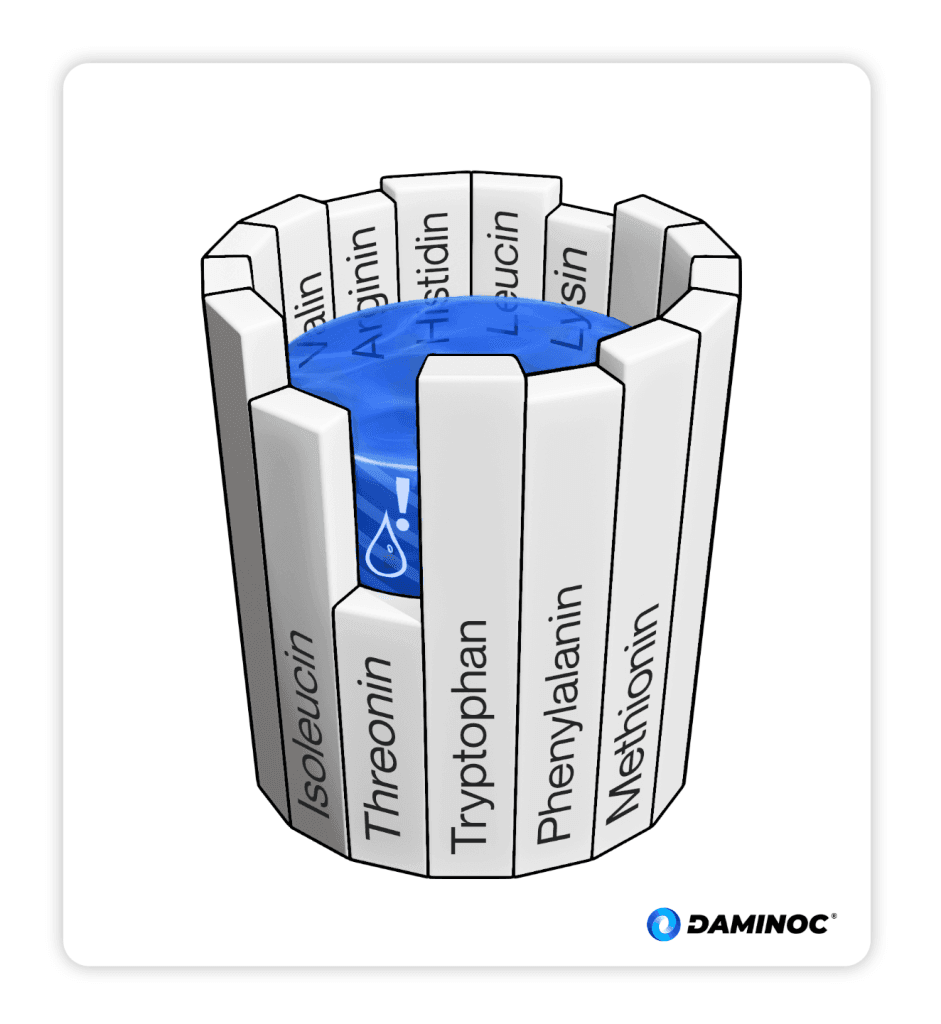
How valuable a protein is for the body depends on two things: how many of its amino acids are actually digested and absorbed, and how well its amino acid profile matches the body’s requirements. If an essential amino acid is missing or present in insufficient quantities, it limits the share the body can use for building its own protein. This limiting component is known as a “limiting amino acid“. [3] In the example shown, tryptophan is the limiting amino acid. Its small amount limits the utilization of all other amino acids in the protein for building protein.

Simply explained: How one amino acid can limit everything
Imagine a barrel in which each board represents an amino acid. If one board is shorter than the others, the water will overflow at exactly this point – the barrel cannot reach its full potential. It works the same way in your body: if an amino acid is missing or not present enough, your body cannot fully use the remaining amino acids for building protein. They are not lost, though – they remain available for energy. And in a varied diet, the profiles of different foods complement each other over the day.
What happens to unused amino acids?
Amino acids that the body does not use for building protein are broken down: the nitrogen is excreted via the urea cycle, and the remaining building blocks are used for energy. [1] For healthy people, studies to date have shown no decline in kidney function from a higher protein intake over the periods studied. [4] Anyone who already has kidney disease should discuss their protein intake with their doctor.
How protein quality is assessed – and what Daminoc® is made of
How scientific bodies assess protein quality
Since 2013, the FAO has recommended the DIAAS (Digestible Indispensable Amino Acid Score) as the method for assessing the quality of dietary protein – as the successor to older assessment methods. It measures how much of each essential amino acid is actually digested and absorbed, relative to the body’s requirements. The limiting amino acid determines the score. [3] Daminoc’s Human Amino Code® contains the nine essential amino acids plus arginine in a ratio the manufacturer has aligned with the amino acid profile of human body protein. [5] That is the manufacturer’s formulation rationale.
The practical role in everyday life
- A practical way to top up the supply of essential amino acids – for example with low-protein meals or after training.
- Essential amino acids are the building blocks of muscle protein synthesis – that is what general research shows. [2]
- 100% vegan and free from sugar, lactose and unnecessary additives. [5]
An expert’s assessment
Prof. Dr. Markus M. Metka is a specialist in gynaecology and an anti-ageing physician in Vienna, and the author of several non-fiction books on health topics. He made the following statements as part of a lecture:

The barrel analogy concerns protein synthesis: if one required amino acid is missing, the formation of new body protein is throttled, while amino acids remain available for other purposes such as energy production. [1]
More background on Daminoc
Our background article explains in detail what Daminoc is made of and the principle the manufacturer used to formulate it.
Click here for the background article
And here you can go straight to the ingredients: Daminoc ingredients
Sources
[1] Open Oregon State, Anatomy and Physiology, chapter 24.4: Protein Metabolism
[2] Jäger R. et al.: International Society of Sports Nutrition Position Stand: Protein and Exercise (Journal of the International Society of Sports Nutrition, 2017)
[3] FAO: Dietary protein quality evaluation in human nutrition (Food and Nutrition Paper No. 92, 2013)
[4] Devries M.C. et al.: Changes in Kidney Function Do Not Differ between Healthy Adults Consuming Higher- Compared with Lower- or Normal-Protein Diets: A Systematic Review and Meta-Analysis (The Journal of Nutrition, 2018)
[5] Daminoc: Ingredients (manufacturer information)