
When we think about aging, most of us focus on one number: our birthday.
Every year, our chronological age increases by one. But the number of candles on a birthday cake tells only part of the story.
What matters just as much is how well our body is actually functioning.
Do we wake up full of energy, or constantly feel fatigued? Do we recover quickly from exercise or illness? Are we maintaining our muscle mass, healthy skin, and vitality, or are these gradually declining?
These changes reflect our biological age—and it can differ significantly from our chronological age.
A person in their sixties may have the biological health of someone much younger, while another individual decades younger may already show signs of accelerated aging.
Modern science is revealing something remarkable:
Aging is not determined by the passing of time alone. To a large extent, our biological aging is influenced by the way we live.
Many of the changes we associate with “getting older” may not simply be a natural consequence of age.
These include:
Of course, aging is a natural process.
However, an increasing body of scientific research suggests that nutrition, physical activity, sleep, stress management, and environmental exposures all influence how quickly that process unfolds.
One of the best examples comes from the world’s Blue Zones—regions where people routinely live healthy lives into their nineties and beyond. Interestingly, these populations often achieve exceptional longevity without relying on advanced medical care. Instead, their lifestyle appears to play the defining role.
Scientists now use several biomarkers to estimate biological age.
One of the most extensively studied is the telomere.
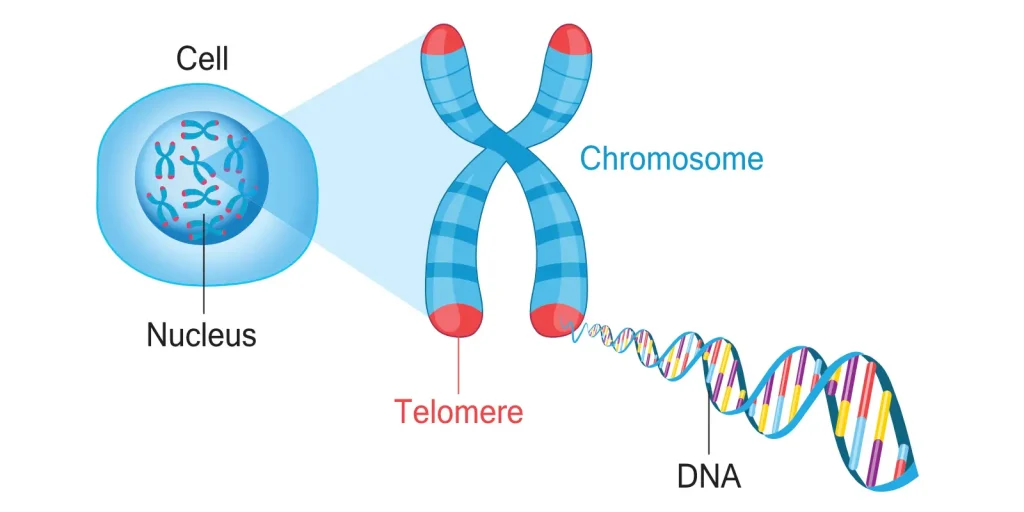
Every cell in the body contains chromosomes that store our complete genetic blueprint.
At the ends of every chromosome are tiny protective structures called telomeres.
They function much like the plastic tips at the ends of a shoelace. As long as those tips remain intact, the shoelace doesn’t unravel.
Telomeres serve a similar purpose by protecting our DNA every time a cell divides.
Our bodies constantly renew themselves.
Old cells die.
New cells are created.
This continuous renewal depends largely on stem cells.
Every time a stem cell divides to produce a new cell, its telomeres become slightly shorter.
This shortening is a normal part of life.
Over time, as telomeres become progressively shorter, cells lose their ability to divide efficiently. As a result, the body’s capacity to repair and regenerate gradually declines.
For this reason, telomere length has become one of the most important biomarkers of biological aging.
The encouraging news is that telomere shortening does not appear to be determined solely by genetics.
Research suggests that several lifestyle factors can influence the rate at which telomeres shorten.
Among the most important are:
Conversely, regular exercise, restorative sleep, balanced nutrition, and maintaining good metabolic health all appear to support healthier cellular aging.
One of the most exciting discoveries in aging research is an enzyme called telomerase.
Telomerase helps maintain—and under certain circumstances may partially restore—the length of telomeres.
In recognition of this groundbreaking discovery, Dr. Elizabeth Blackburn was awarded the Nobel Prize in Physiology or Medicine in 2009.
Today, research suggests that healthy lifestyle habits—including proper nutrition, physical activity, stress reduction, and adequate sleep—may positively influence telomerase activity.
This does not mean we can stop aging.
However, it does suggest that biological aging is considerably more dynamic and modifiable than previously believed.
Every day, our bodies repair damaged tissues and build millions of new cells.
To accomplish this, they require much more than calories.
They need the proper building materials.
Vitamins, minerals, and antioxidants help protect cells from oxidative damage.
Equally important are essential amino acids, which provide the building blocks for virtually every protein the body produces.
Muscle tissue, enzymes, hormones, connective tissue, collagen, skin, immune cells, and countless other structures all depend on an adequate supply of essential amino acids.
When these nutrients are insufficient—or not available in optimal proportions—the body’s repair and rebuilding processes become less efficient.
Healthy aging begins by asking two simple questions.
Examples include:
Our bodies create millions of new cells every single day.
The quality of those cells depends largely on the nutrients available during that process.
This is where the Daminoc® concept begins.
The Human Amino Code® provides all essential amino acids in a ratio designed to reflect the body’s physiological requirements. These amino acids support normal protein synthesis—the foundation for building and maintaining muscle, enzymes, hormones, connective tissue, and many other essential structures throughout the body.
For those seeking additional support for recovery, connective tissue, skin, tendons, and joints, Daminoc® 10 EAA Collagen Pro+ combines the Human Amino Code® with collagen peptides, creatine, glycine, vitamin C, and other carefully selected ingredients that complement the body’s natural rebuilding processes.
It is important to emphasize that no dietary supplement can stop aging or directly lengthen telomeres. Healthy nutrition, regular exercise, quality sleep, and an overall healthy lifestyle remain the cornerstones of healthy aging. Targeted nutritional support, however, can provide the body with the essential building blocks it requires to perform these processes efficiently.
We cannot change our chronological age.
But every day, we influence our biological age.
Every meal.
Every night’s sleep.
Every workout.
And every building block we provide to our body.
Because your body is rebuilding itself every single day.
The real question is therefore not simply how old you are—but what you’re giving your body to build with.